AI-Based DeepLabV3-DenseNet for Non-Invasive Detection of Microsatellite Instability in Colorectal Cancer
Keywords:
Abstract
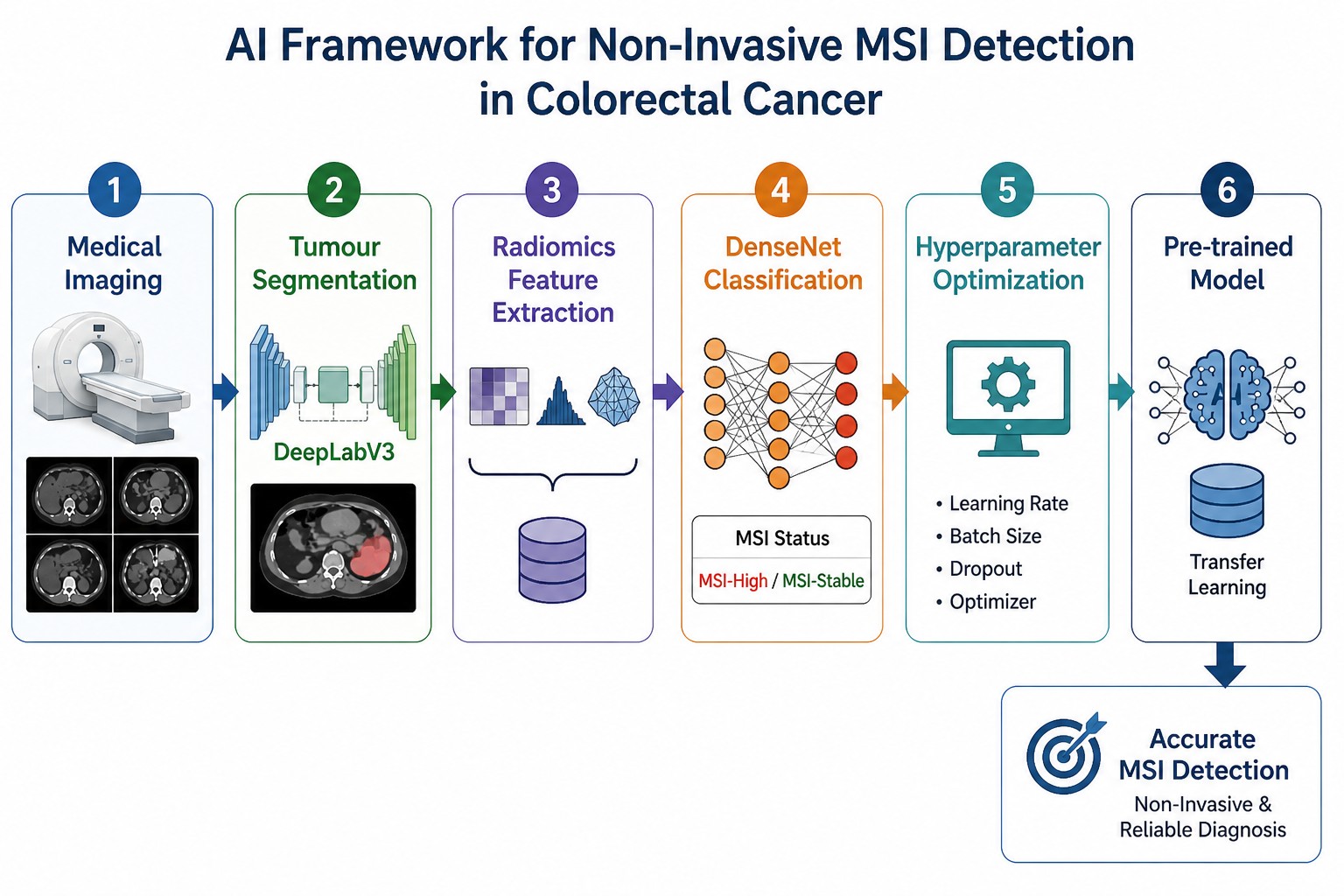
Microsatellite instability (MSI) is a crucial biomarker in colorectal cancer (CRC), playing a significant role in prognosis, treatment planning, and response to immunotherapy. Conventional MSI detection techniques, including polymerase chain reaction (PCR) and immunohistochemistry (IHC), are invasive, time-consuming, and costly. With the advancement of artificial intelligence (AI), non-invasive MSI detection using medical imaging and computational methods has gained considerable attention. Deep learning architectures such as DeepLabV3 and Dense Net have demonstrated exceptional performance in image segmentation and classification tasks, enabling automated tumour localization and MSI prediction. Radiomics further enhances these models by extracting high-dimensional quantitative features from medical images, capturing tumour heterogeneity and underlying biological characteristics. Hybrid frameworks combining DeepLabV3-based segmentation and Dense Net-based classification, along with hyperparameter optimization techniques, have shown improved predictive accuracy and robustness. Additionally, pre-trained models and transfer learning approaches reduce data dependency and enhance generalization across datasets. This review provides a comprehensive analysis of recent advancements in AI-driven MSI detection, focusing on deep learning, radiomics, and optimization techniques. The study highlights the strengths, limitations, and future research directions, emphasizing the need for scalable, interpretable, and clinically applicable AI-based systems for colorectal cancer diagnosis.