Deep Learning and Optimization Approaches in Adaptive Recalling-Enhanced Recurrent Neural Network based Predictive Control for the Nano Positioning of an Electrostatic MEMS Actuator: A Review
Keywords:
Abstract
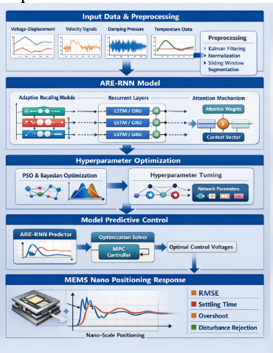
Micro-Electro-Mechanical Systems (MEMS) actuators have emerged as pivotal components in precision engineering, biomedical instrumentation, optical systems, and semiconductor fabrication, where nanometer-scale positioning accuracy is paramount. Electrostatic MEMS actuators, in particular, present compelling advantages in terms of low power consumption, rapid dynamic response, and fabrication compatibility with standard CMOS processes. However, achieving precise nano-scale positioning remains a formidable challenge due to the inherent nonlinearities, pull-in instability, hysteresis, and parametric uncertainties that characterize these devices. This review paper systematically examines the convergence of deep learning methodologies and optimization strategies within the framework of Adaptive Recalling-Enhanced Recurrent Neural Network (ARE-RNN) based predictive control architectures applied to electrostatic MEMS actuator nano positioning. A comprehensive synthesis of thirty seminal studies is presented, covering the evolution from classical model predictive control to intelligent learning-based frameworks incorporating Long Short-Term Memory (LSTM), Gated Recurrent Units (GRU), attention mechanisms, and transformer-based architectures. Optimization paradigms including Particle Swarm Optimization, Genetic Algorithms, Bayesian Optimization, and gradient-based hyperparameter tuning are critically analyzed. The review further identifies persistent challenges including real-time computational constraints, sensor noise sensitivity, and generalization across fabrication variations, while delineating promising future directions encompassing federated learning, neuromorphic computing, and physics-informed neural networks for next-generation MEMS control systems.