
Sustainable Supply Chain Management in Road Construction Projects
DOI:
https://doi.org/10.65521/ijacect.v15i1.2450Keywords:
Abstract
Background: Road construction in India continues to depend heavily on virgin aggregates and freshly refined bitumen materials whose extraction and processing carry significant environmental and economic costs. As infrastructure demand grows, so does the pressure on natural resources and supply chain efficiency. Sustainable Supply Chain Management (SSCM) offers a framework for addressing this tension by embedding recycling, waste reduction, and resource efficiency into construction practice. Reclaimed Asphalt Pavement (RAP), obtained by milling existing road surfaces, represents one of the most practical and scalable applications of SSCM in pavement engineering. Despite its recognised potential, locally verified performance data for RAP-incorporated mixes under Indian highway conditions remains limited.
Methods: This study investigated the incorporation of 30% RAP into a Bituminous Concrete Grade-II mix designed for surface course application. RAP material was collected from National Highway-16, Visakhapatnam, and tested alongside virgin aggregates and VG-30 bitumen for physical and mechanical properties. Mix design was carried out using the Marshall Stability method as per MoRTH Section 500 specifications. Marshall specimens were prepared at five bitumen contents ranging from 4.5% to 6.5%, and performance parameters including stability, flow value, bulk density, and air voids were evaluated for both the RAP mix and a conventional control mix. A project-level cost analysis and environmental impact assessment were also conducted.
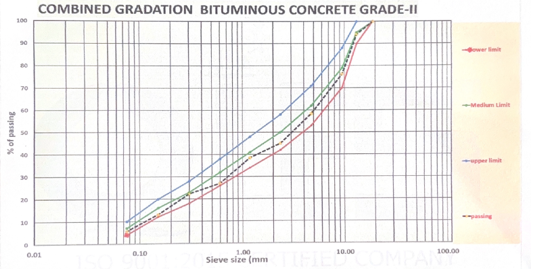
Results: The RAP mix achieved a Marshall Stability of 15.2 kN at an optimum bitumen content of 5.3%, compared to 14.0 kN at 5.5% for the conventional mix. Bulk density improved marginally to 2.40 g/cc, air voids remained within the MoRTH-specified 3–5% range at 3.8%, and flow value of 2.9 mm confirmed adequate flexibility. The combined gradation of RAP and virgin aggregates satisfied BC Grade-II specification limits at every sieve size. Cost analysis showed the RAP mix at Rs. 4,350 per metric tonne against Rs. 5,159 for the conventional mix, yielding a saving of Rs. 6.21 lakhs per kilometre of standard overlay work a reduction of approximately 15–16%.
Conclusion: The 30% RAP mix met and exceeded all MoRTH performance requirements while delivering measurable cost savings and reduced environmental impact through lower virgin material consumption and avoided landfill disposal. The findings confirm that RAP incorporation at this content level is technically sound, economically justified, and consistent with sustainable supply chain principles for modern road construction in India.
Downloads
Published
How to Cite
Issue
Section
License

This work is licensed under a Creative Commons Attribution-NoDerivatives 4.0 International License.
