Flood and Landslide Monitoring System Using Machine Learning
DOI:
https://doi.org/10.65521/ijeecs.v15i1S.2958Keywords:
Abstract
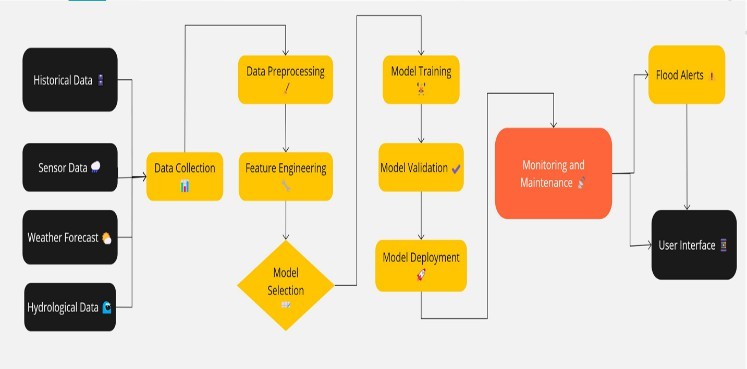
Floods and landslides are among the most devastating natural disasters, leading to severe damage to infrastructure, environmental degradation, and loss of human life. These disasters are especially frequent in regions with complex terrain and heavy rainfall patterns, such as India. Accurate and timely prediction of such events is essential to minimize their impact and improve disaster preparedness. This paper presents a comprehensive machine learning-based flood and landslide monitoring system that utilizes Convolutional Neural Networks (CNN) and Logistic Regression for prediction. The system integrates heterogeneous data sources, including meteorological data (rainfall, temperature, humidity), hydrological data (river levels, soil moisture), and geographical data (elevation, slope, land use patterns). CNN is employed for extracting spatial features from geospatial and satellite data, while Logistic Regression is used as a classification model to predict the probability of flood and landslide occurrences. The proposed system includes data preprocessing, feature extraction, model training, and real- time prediction modules. The model is trained on historical datasets and evaluated using performance metrics such as accuracy, precision, recall, and F1-score. The results demonstrate that the hybrid approach improves prediction accuracy compared to traditional methods. Furthermore, the system supports early warning generation, enabling timely intervention by authorities. This research contributes to the development of intelligent disaster management systems aimed at reducing risks and enhancing community resilience.