AI-Based Resource Allocation and Task Scheduling Using Hierarchical Polynomial Convolutional Neural Networks
DOI:
https://doi.org/10.65521/ijeecs.v14i2.2865Keywords:
Abstract
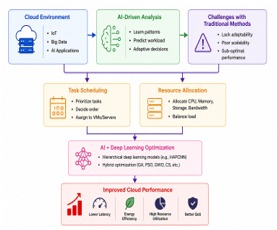
Cloud computing has emerged as a dominant paradigm for scalable and on-demand resource provisioning. However, efficient resource allocation and task scheduling remain critical challenges due to dynamic workloads, heterogeneous resources, and multi-objective optimization constraints such as cost, latency, and energy consumption. Traditional heuristic and rule-based scheduling approaches often fail to adapt to real-time variations and complex dependencies. In this context, Artificial Intelligence (AI) techniques, particularly deep learning and optimization-based hybrid models, have gained significant attention. This paper presents a comprehensive review of AI-driven resource allocation and task scheduling strategies in cloud computing, with a specific focus on hierarchical auto-associative polynomial convolutional neural networks (HAPCNN). The study explores recent advancements in machine learning, deep reinforcement learning, and hybrid metaheuristic approaches that enhance system efficiency and Quality of Service (QoS). Furthermore, the paper identifies key trends such as hybrid optimization models, predictive scheduling, and intelligent load balancing, while also discussing open challenges including scalability, energy efficiency, and security. The findings highlight that AI-integrated scheduling frameworks significantly outperform traditional methods in terms of makes pan reduction, throughput improvement, and resource utilization. This review serves as a valuable reference for researchers aiming to design next-generation intelligent cloud resource management systems.