Reinforcement Learning-Based Autonomous Multi-Agent Systems for Cooperative Task Allocation and Optimization
DOI:
https://doi.org/10.65521/ijeecs.v14i2.2723Keywords:
Abstract
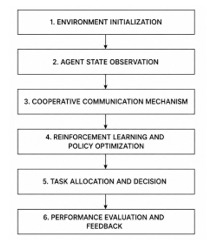
Reinforcement Learning (RL)-based Autonomous Multi-Agent Systems (AMAS) have emerged as an advanced paradigm for solving complex cooperative task allocation and optimization problems in dynamic and uncertain environments. Conventional centralized optimization approaches often face limitations related to scalability, adaptability, communication overhead, and real-time decision-making in distributed systems. In contrast, RL-driven multi-agent frameworks provide decentralized intelligence, adaptive learning, and cooperative coordination capabilities that significantly enhance operational efficiency across domains such as robotics, smart manufacturing, autonomous transportation, wireless sensor networks, cloud-edge computing, and intelligent logistics. This study presents a comprehensive framework for reinforcement learning-based autonomous multi-agent systems emphasizing cooperative task allocation, distributed optimization, and collaborative decision-making strategies. The proposed model integrates Multi-Agent Reinforcement Learning (MARL), cooperative reward-sharing mechanisms, dynamic state-space representation, and decentralized policy optimization to improve resource utilization, reduce task completion time, and maximize overall system performance. Advanced RL techniques including Deep Q-Networks (DQN), Proximal Policy Optimization (PPO), Multi-Agent Deep Deterministic Policy Gradient (MADDPG), and Actor–Critic methods are utilized to enable adaptive coordination among autonomous agents. The research also addresses critical challenges such as non-stationarity, scalability, exploration–exploitation balance, communication constraints, and convergence instability in cooperative environments. Simulation results demonstrate substantial improvements in task execution efficiency, cooperative adaptability, energy optimization, and system robustness compared with traditional heuristic and centralized optimization approaches, highlighting the growing significance of intelligent multi-agent frameworks in next-generation autonomous and industrial systems.