A Comprehensive Review of Dual-Stage Interleaved Onboard Charger with PIDD2-PD Controller and Hybrid Adaptive Genghis Khan Shark Gold Rush for Electric Vehicles
DOI:
https://doi.org/10.65521/ijeecs.v13i2.2675Keywords:
Abstract
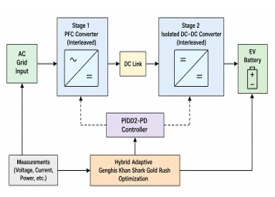
The rapid growth of electric vehicle (EV) adoption has driven the need for efficient and intelligent onboard charging systems. Dual-stage interleaved onboard chargers have emerged as a promising solution due to their ability to enhance power density, reduce current ripple, and improve overall efficiency. However, their nonlinear dynamics and coupled interactions present significant challenges for control and optimization, making conventional methods insufficient. This review focuses on advanced control and optimization techniques for dual-stage interleaved onboard chargers, emphasizing the integration of the PIDD2-PD controller with a hybrid adaptive Genghis Khan Shark Gold Rush optimization algorithm. The PIDD2-PD controller improves transient response and system stability, while the hybrid optimization approach enables efficient exploration of complex design spaces and real-time parameter tuning. The study also examines the role of wide-bandgap semiconductor technologies and digital control platforms in enhancing charger performance. Applications across simulation and hardware implementations are discussed, along with key performance metrics such as efficiency, power factor, and harmonic distortion. Findings indicate that hybrid control-optimization frameworks significantly improve charger performance, offering a scalable and intelligent solution for next-generation EV charging systems and smart grid integration.