A Survey of Methods and Architectures for Enhancing Thermo-Electro-Mechanical Responses of MEMS Resonant Accelerometers with an Attention-Guided Siamese Fusion Neural Network
DOI:
https://doi.org/10.65521/ijeecs.v13i2.2664Keywords:
Abstract
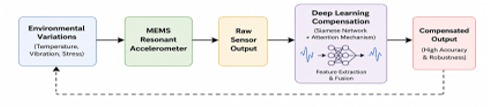
Microelectromechanical systems (MEMS) resonant accelerometers are highly advanced sensing devices that integrate mechanical, electrical, and thermal principles to measure extremely small accelerations through resonance frequency variations. These devices rely on precise interpretation of frequency shifts, which are influenced by complex thermo-electro-mechanical interactions such as thermoelastic damping, electrostatic nonlinearities, residual stresses, and temperature-dependent material properties. Traditional compensation techniques, including polynomial temperature correction and differential measurement methods, often struggle to adapt to variations caused by environmental changes, device aging, and manufacturing inconsistencies. This survey reviews recent advancements in enhancing MEMS accelerometer performance, with a focus on attention-guided Siamese fusion neural networks as a unified solution for multiphysics signal processing challenges. The Siamese architecture enables effective comparison of dual sensor outputs by learning meaningful feature representations, while attention mechanisms selectively emphasize critical spectral and temporal features, improving noise suppression and signal clarity. Fusion strategies further integrate thermal and acceleration data for improved calibration and accuracy. The reviewed studies cover diverse datasets from experimental prototypes, commercial systems, and simulation models, with applications spanning navigation, structural monitoring, and wearable devices. Overall, these intelligent approaches provide a scalable and adaptive framework for next-generation MEMS accelerometers, enabling improved accuracy, robustness, and real-time performance in complex operating environments.