Substituent and Structural Determinants in the Chromium(VI) Oxidation of Substituted Mandelic Acids: Taft Correlation, Decarboxylation Pathways, and Mechanistic Evolution Across PCC, PDC, QDC, and TBAD
Keywords:
Abstract
The chromium(VI) oxidation of mandelic acid derivatives provides a sensitive platform for probing how substrate electronics and oxidant structure cooperatively govern reaction pathways. In this study, mandelic acid and a series of para-substituted derivatives (p-NO₂, p-Cl, H, p-CH₃, p-OCH₃) were oxidized using four chromium(VI) reagents, pyridinium chlorochromate (PCC), pyridinium dichromate (PDC), quinolinium dichromate (QDC), and tetrabutylammonium dichromate (TBAD), under comparable acidic and solvent conditions. Electronic and structural effects were systematically examined through pseudo–first-order kinetics, Taft σ* correlations, stoichiometric Cr(VI) consumption, product characterization via 2,4-dinitrophenylhydrazone derivatives, and qualitative CO₂ evolution studies.
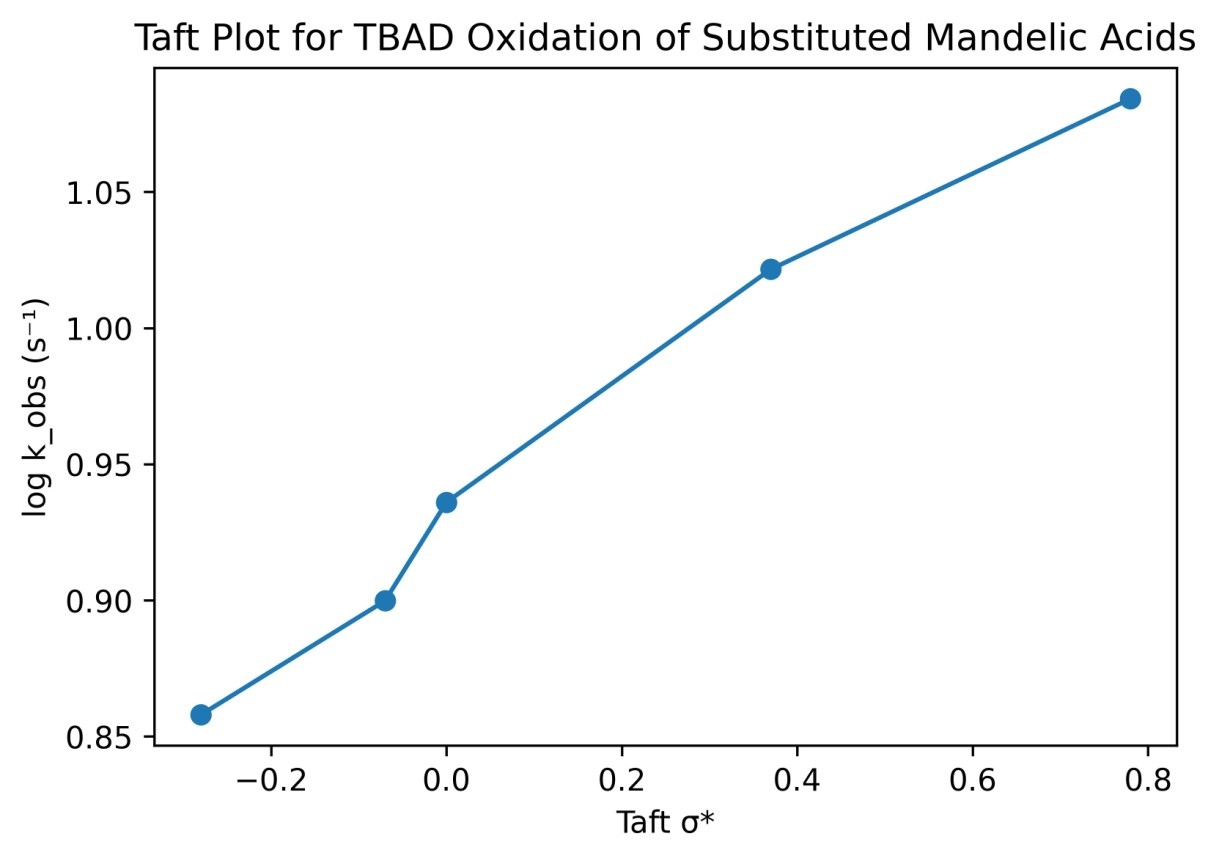
Taft correlations reveal a pronounced increase in substituent sensitivity across the oxidant series, with low ρ values for PCC (ρ ≈ 0.8), moderate values for PDC, and large positive slopes for QDC (ρ ≈ 1.86) and TBAD (ρ ≈ 2.11). These tendencies reveal that there is a progressive rise in electron deficiency at the α-carbon in the transition state, which is in line with the changing dominance from weakly associated chromate ester pathways in PCC to increasingly substrate–chromium interactive pathways in QDC and TBAD. PCC predominantly effects two-electron oxidation to α-keto acids, whereas QDC and TBAD promote oxidative decarboxylation under electronically favorable conditions, reflected in higher effective Cr(VI) consumption ratios. The identities of the products were confirmed by the 2,4-dinitrophenylhydrazone derivatives characterized by melting point comparison. All of these findings show a distinct mechanistic order of Cr(VI) oxidants, which are both oxidant architecture- and substrate electronic effect-dependent. The results indicate that oxidative decarboxylation becomes competitive when significant transition-state polarization and effective substrate–chromium interaction are present. This article offers a single electronic-mechanistic model on the Cr(VI) oxidations of α-Hydroxy acids.