
AI OPS Log Anomaly Detector – A Lightweight Unsupervised Framework for Log Analysis, Detection, And Visualization
DOI:
https://doi.org/10.65521/ijasret.v10i3.2287Keywords:
Abstract
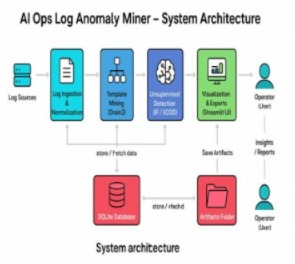
System logs are a primary source of information for monitoring and maintaining modern software systems. However, the growing volume and complexity of logs make manual inspection inefficient and error-prone. Traditional log analysis tools either depend on predefined rules or require heavy infrastructure, limiting their usability in small-scale or offline environments. This work presents a lightweight and interactive log anomaly detection system that integrates template mining, feature extraction, and unsupervised machine learning within a unified interface. The system allows users to upload log files, process them through structured pipelines, and detect anomalies using models such as Isolation Forest, ECOD, and Local Outlier Factor. Feature extraction techniques include TF-IDF vectorization, optional semantic embeddings, and statistical feature generation, enabling comprehensive representation of log behavior. A key aspect of the system is its user-centric design, where all processing stages—from ingestion to visualization—are accessible through an intuitive interface. Users can perform operations such as parsing logs, extracting features, running anomaly detection, and visualizing results using timeline charts and distribution plots. The system also supports exporting results in multiple formats, ensuring usability for further analysis. Overall, the framework provides a practical and explainable solution for log anomaly detection, emphasizing simplicity, transparency, and offline capability. It is particularly suitable for academic, research, and small enterprise environments where lightweight deployment and interactive analysis are essential.
Downloads
Published
How to Cite
Issue
Section
License

This work is licensed under a Creative Commons Attribution-NoDerivatives 4.0 International License.
