Recent Advances in Similarity-Navigated Graph Neural Networks and Lightweight Cryptography for Preventing Black Hole Attacks in MANET: A Systematic Review
Keywords:
Abstract
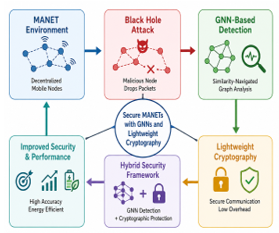
Mobile Ad Hoc Networks (MANETs) are decentralized wireless systems that rely on cooperative routing among mobile nodes, making them highly vulnerable to routing attacks such as black hole attacks. In this attack, malicious nodes falsely advertise optimal routes and drop intercepted packets, leading to severe degradation in network performance. Recent advancements in artificial intelligence and lightweight cryptographic techniques have provided promising solutions to address these vulnerabilities. This paper presents a systematic review of similarity-navigated Graph Neural Networks (GNNs) and lightweight cryptographic mechanisms for detecting and preventing black hole attacks in MANETs. GNNs effectively model network topology and node relationships, enabling anomaly detection based on structural and behavioral similarity. Meanwhile, lightweight cryptography ensures secure communication with minimal computational overhead, making it suitable for resource-constrained environments. The review focuses on studies published in recent years, analyzing machine learning, deep learning, and hybrid approaches integrating GNNs, blockchain, and optimization techniques. Comparative analysis reveals that hybrid frameworks combining GNN-based detection and cryptographic security outperform traditional methods in terms of accuracy, throughput, and energy efficiency. However, challenges such as scalability, real-time detection, and adversarial robustness remain. The study concludes with future research directions for developing secure and efficient MANET architectures.