A Comprehensive Review of An Optimized Dynamic Deep Unfold Network Model For Predicting Cardiac Arrhythmias Based On 12 Lead ECG Signals
Keywords:
Abstract
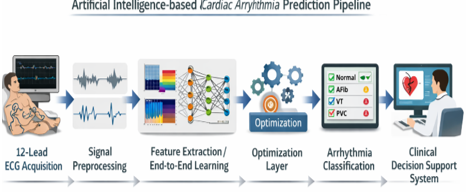
Cardiac arrhythmias represent a significant global health concern, often leading to severe complications such as stroke, heart failure, and sudden cardiac death. The advancement of deep learning techniques has enabled the development of automated systems for accurate and early detection of arrhythmias using electrocardiogram (ECG) signals. In particular, 12-lead ECG signals provide comprehensive cardiac information, making them highly suitable for robust diagnostic modeling. This paper presents a comprehensive review of optimized dynamic deep unfold network models for predicting cardiac arrhythmias based on 12-lead ECG signals. The study explores how deep unfolding integrates model-based optimization with data-driven learning to enhance interpretability and performance. Various architectures, including convolutional neural networks, recurrent neural networks, and hybrid deep unfolding frameworks, are examined in the context of arrhythmia classification. Furthermore, optimization strategies such as attention mechanisms, sparsity constraints, and adaptive learning are discussed. The review highlights recent advancements, challenges, and future research directions in this domain. Emphasis is placed on improving classification accuracy, computational efficiency, and clinical applicability. The findings suggest that optimized dynamic deep unfolding models hold significant potential in transforming automated cardiac diagnostics and enabling real-time clinical decision support systems.