Deep Learning and Optimization Approaches in Prediction of Routing Scenarios for IoT-based MANETs using Expanding Ring Search and RED Parameters with Global Pooling Dilated CNN: A Review
DOI:
https://doi.org/10.65521/ijaece.v14i2.2703Keywords:
Abstract
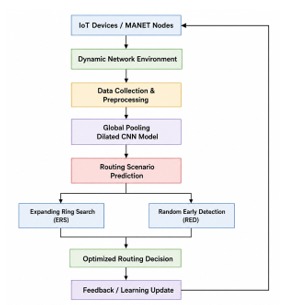
Mobile Ad Hoc Networks (MANETs) integrated with the Internet of Things (IoT) represent a highly dynamic and decentralized communication paradigm characterized by mobility, resource constraints, and unpredictable topology changes. Traditional routing protocols such as AODV, DSR, and DSDV struggle to efficiently adapt to such environments due to issues like high latency, congestion, packet loss, and routing overhead. Emerging techniques incorporating deep learning and optimization strategies have shown significant potential in predicting routing scenarios and improving network performance. This review focuses on advanced approaches that combine Expanding Ring Search (ERS) and Random Early Detection (RED) mechanisms with deep learning architectures, particularly global pooling dilated Convolutional Neural Networks (CNNs), to enhance routing efficiency. ERS reduces route discovery overhead by limiting search radius, while RED helps in congestion avoidance by early packet dropping. Integrating these mechanisms with deep learning enables intelligent prediction of optimal routing paths under varying network conditions.The paper analyzes recent studies on deep learning-based routing, reinforcement learning, and optimization techniques in IoT-enabled MANETs. Comparative analysis highlights improvements in packet delivery ratio, throughput, latency, and energy efficiency. The study also discusses challenges such as scalability, computational complexity, and real-time adaptability. Finally, future directions emphasize hybrid AI models, federated learning, and edge intelligence for next-generation MANET routing systems.