A Comprehensive Review of IoT-Based Soil Nutrition and Plant Disease Detection System for Smart Agriculture Using Multi-Layer Stacked Residual Coordinate Boosted Sooty Tern Attention Network
DOI:
https://doi.org/10.65521/ijaece.v14i1.2692Keywords:
Abstract
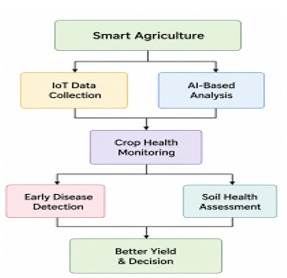
Smart agriculture has become an important approach for improving crop productivity, ensuring food security, and reducing resource wastage through the integration of IoT, Artificial Intelligence (AI), and deep learning technologies. Traditional agricultural practices mainly depend on manual monitoring of soil conditions and plant diseases, which is often inefficient, time-consuming, and prone to human error. IoT-enabled systems provide real-time monitoring of critical soil parameters such as moisture, pH, temperature, and nutrient levels using smart sensors and connected devices. The collected data are analyzed using advanced deep learning models to support predictive analysis and automated decision-making. Deep learning architectures such as Convolutional Neural Networks (CNNs), Residual Networks (ResNet), and Vision Transformers (ViT) have shown remarkable performance in plant disease detection and classification. Furthermore, hybrid frameworks integrating residual learning and attention mechanisms significantly improve feature extraction and classification accuracy. The proposed Multi-Layer Stacked Residual Coordinate Boosted Sooty Tern Attention Network combines coordinate attention, residual connections, and transformer-based learning for enhanced spatial and contextual feature representation. These intelligent systems enable early disease prediction, accurate soil health assessment, and optimized agricultural resource utilization. Recent studies demonstrate that deep learning-based agricultural systems can achieve disease classification accuracies exceeding 95%, improving overall farming efficiency and sustainability.