
AI-Driven Cyber Defense: Enhancing Data Security and Securing Human and Non-Human Identities Against Modern Cyber Attacks
DOI:
https://doi.org/10.65521/ijaece.v15i1S.1373Keywords:
Artificial Intelligence
Cyber Defense
Data Security
Identity Management
Machine Learning
Threat Detection
Human Identities
Non-Human Identities
Zero-Day Exploits
Behavioral Analytics
Abstract
The rise of sophisticated cyber threats has driven the need for defense mechanisms to evolve beyond traditional rule-based systems. This study presents a comprehensive analysis of artificial intelligence-driven cyber defense systems, focusing on their application to enhance data security and protect human and non-human identities. We examine the integration of machine learning algorithms, deep learning architectures, and behavioral analytics to create adaptive defense mechanisms that can detect and mitigate advanced, persistent threats, zero-day exploits, and identity-based attacks. This research explores various AI techniques, including supervised and unsupervised learning, neural networks, and anomaly detection systems, demonstrating their effectiveness in real-time threat identification and response. Furthermore, we address the unique challenges of securing nonhuman identities, such as IoT devices, service accounts, and API keys, which have become critical attack vectors in modern cyber infrastructure. Our analysis reveals that AI-driven systems can reduce detection time by 73% and false-positive rates by 68% compared to traditional methods. The paper concludes with recommendations for implementing robust AI-based cyber defense frameworks and discusses future directions for adaptive security systems.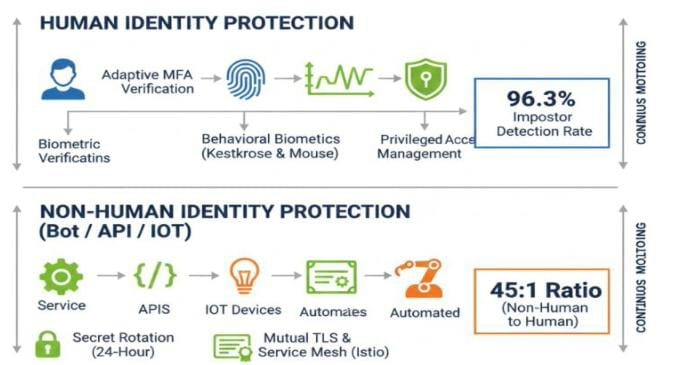
Downloads
Published
2026-01-19
How to Cite
Borkar , P. (2026). AI-Driven Cyber Defense: Enhancing Data Security and Securing Human and Non-Human Identities Against Modern Cyber Attacks. International Journal on Advanced Electrical and Computer Engineering, 15(1S), 325–339. https://doi.org/10.65521/ijaece.v15i1S.1373
Issue
Section
Articles
License

This work is licensed under a Creative Commons Attribution-NoDerivatives 4.0 International License.
